
Kimchi Jjigae
The anatomy of kimchi jjigae: ins and outs.

Dear readers,
Before we dive into today’s newsletter, I’d like to share a small change to the format going forward. From now on, Simple Supper will arrive every Saturday at 10am, bringing you something new each week. The newsletter will alternate between free editions and premium content for paid subscribers.
My 5 meal ideas, On the Menu and A Simple Supper in a Flash will remain free and arrive every other week, starting next Saturday. Today’s edition is One to Keep, my premium recipe feature, where I share dishes worth returning to again and again. These will also appear every other week, and you will have the chance to vote on what you’d like to see next - making future newsletters more interactive and shaped by you.
Now, let’s dive into the world of kimchi jjigae where time, tradition, and technique come together in perfect harmony to create a depth of flavour that is unmistakably Korean.
Every pot of kimchi jjigae begins long before the hob. And the secret to great kimchi jjigae isn’t the recipe. It’s understanding the kimchi you begin with.
In my first book, Rice Table, across the two chapters on ferments and pickles, and soups and stews, I write about the moment I first rediscovered the taste of home that would satisfy my quiet, persistent longing for a sense of belonging. It began with a long forgotten tub of kimchi that I had bought from a shop.
At first, it tasted overwhelmingly salty and bitter, the cabbage still raw and underdeveloped. The flavours felt disjointed, leaving me with a strange, bittersweet disappointment - recognisably kimchi, yet far from the taste I carried in memory. I wrapped the Tupperware tightly and tucked it at the back of the fridge.
Some time later, I reluctantly returned to the tub, wondering if that time had done what it does best. The once-mediocre kimchi was now pungent and sour, boasting a depth of flavour as deep as the earthen jars buried through winter back home. And I knew exactly what it needed to become: kimchi jjigae.
I tended the pot almost instinctively, guided by years of observation sewn into my muscle memory. I stirred slowly, tasting and adjusting as I went, to tease out the flavour. And indeed, it brought me right back to my parents’ kitchen. The room filled with the delicate smell of anchovies. I felt the broth slip across my tongue with rich, almost silky viscosity. I heard my mother whisper and saw my father leaning over the pot, slurping loudly in praise of the bubbling stew.
He would say siwonhada, meaning refreshing - a word that describes the taste sensation experienced through body as much as on the tongue. Only in Korean could a molten, steaming broth tastes refreshing and everyone at the table would understand exactly what that means.
But no two kimchi - and no two kithchens - are ever the same.
Kimchi is notoriously personal. It is an expression of flavour shaped not only by cooks hand, but also by regions, climate and family tradition. Some lean heavily on fermented seafood, rich with salinity and umami. Others are brighter, spicier or sweeter. With such different starting points - each punctuated by its distinct accent - the same kimchi jjigae recipe can lead to vastly different bowls of stew.
And of course, kimchi itself is not static. It is an ever-evolving live ingredient. The way we cook with it should be guided by its age. A young kimchi - still bright and crisp and not yet fully fermented - needs an encouragement while aged kimchi with its deeper complexity, asks for respect.
Yet most kimchi jjigae recipes focus only on lists, ingredients to add, steps to follow, quantities to measure, driven by the necessities of a recipe. But they often miss the most important element of the dish: paying attention to the kimchi you begin with.
For me, to cook kimchi jjigae well means responding to the kimchi in front of you. It means understanding why you are adding sugar and when. Knowing when sharpness needs rounding with fat. Or choosing to add nothing at all when the restraint is the most respectful choice.
Recipes often emphasise tasting as you go, and of course that matters. But tasting alone isn’t enough if you don’t yet know what you’re looking for. You need something more solid to guide the course from ‘not-quite-sure’ to undeniably delicious.
Intuitive cooking, backed by knowledge - knowing which technique to apply, and when - is how you answer.
So where do we start?
We first bloom the kimchi to improve the lacklustre texture. Sautéing the kimchi first sweats out the moisture, concentrates the flavour and slowly caramelises the seasoning to intensify the taste. This process of ‘drying out’ allows any additions to amalgamate more harmoniously without dilution, while the original tone of kimchi is strengthened. With well-aged kimchi, little else is needed, other than a touch of sugar to balance the pronounced acidity of long fermentation. Younger or less flavoursome kimchi, however, benefits from additional seasoning. Blooming gochugaru with kimchi can work wonders, injecting both colour and fruity heat as its fat-soluble flavours are released. As it cooks down in fat, the sharp edges of kimchi soften, its flavour enhanced, leaving a rounder, more balanced acidity.
Why fat matters - and why pork often
Aged kimchi often carries an acidity that is too sharp to enjoy uncooked. When combined with fat, these strong flavours complement each other: the fat rounds the sharpness while the acidity cutting through the richness of the fat, highlighting only the best qualities of each other. Pork fat has long been a classic companion for well-fermented kimchi for precisely this reason. In days when meat was expensive, a lump of pork fat, or cheaper fatty cuts would be rendered down with kimchi, creating a stew with rich pork flavour and a velvety broth.
It makes sense why we often see Spam in kimchi jjigae - an economical, pocket-friendly substitute designed to achieve a similar effect. You can also cook with olive oil: I sometimes use tinned tuna or sardines in a good quality olive oil, using every last drop to cook the kimchi down almost confit-style. You need more oil than you might think, so that the fat continues its journey to meld into the broth, allowing the kimchi and its other companions to mingle and harmonise better.
To brown or not to brown?
Growing up, I never saw anyone browning the meat in kimchi jjigae. While some cooks today use browning to trigger the Maillard reaction and boost flavour, it is not a common practice in traditional Korean cooking. To be quite honest, I have not found browning to improve the flavour in kimchi jjigae; if anything, it can dry out the meat. I much prefer the traditional practice: briefly cooking the meat until the pink phases to a light brown, which keeps it juicy and tender in the stew.
Stock or water?
Many recipes emphasise the stock but in most Korean cooking, the liquid element is often simply water. If stock is used, it is usually a delicate anchovy-based stock, designed to support the dish, not overpower it. When using a proper chunk of meat in kimchi jjigae, I only ever use water. If tinned fish is used, a light dasima or fish stock can accentuate the taste of the ocean. Starchy water saved from the third rounds of washing rice is often used to give the stew a subtle yet voluminous finish. If more richer finish is desired, use Korean-style milky bone broth. The broth should be reduced slowly, building a structure that supports the rich flavours of kimchi. It should have the body that clings lightly to the spoon, carrying an energy matched to the pungency of kimchi.
how to harness the seasoning
Young kimchi, early in fermentation, tastes snappy with most of its flavour barely sitting on the surface. It needs to be coaxed gently at the start and cooked slower and longer to relax its bouncy muscles. Once softened with plenty of gochugaru, it benefits from a richer stock - bone broth or pork stock - to add body to the stew. Fish sauce, doenjang, gochujang, salted shrimp, shrimp paste and vinegar are your usual allies in balancing the notes of salinity, umami and salivating acidity. Aged kimchi, by contrast, requires restraint, with sugar and fat taking the lead in taming its already complexed tanginess.
What else to add?
Once all the elements are in balance, all you truly need is tofu. Spring onion adds a welcome freshness, and though not traditional, I enjoy a sprinkle of coarsely ground toasted sesame seeds for the pleasure of the nose - their aroma rising the moment the dish reaches the table. The ultimate way to enjoy this comforting homestyle stew is alongside a crisp fried egg (or Korean egg roll, gyeranmari) and gim, seasoned toasted seaweed, a combination beloved by those of us who grew up with kimchi jjigae.
So, every kimchi jjigae begins with the forgotten jar quietly fermenting in your fridge, where time and nature nurtures its flavour into something uniquely intimate to you and your home. The personality of your kimchi becomes the seasoning of the dish, and you are in charge of its final destination.
One to Keep
Kimchi Jjigae with Pork Belly
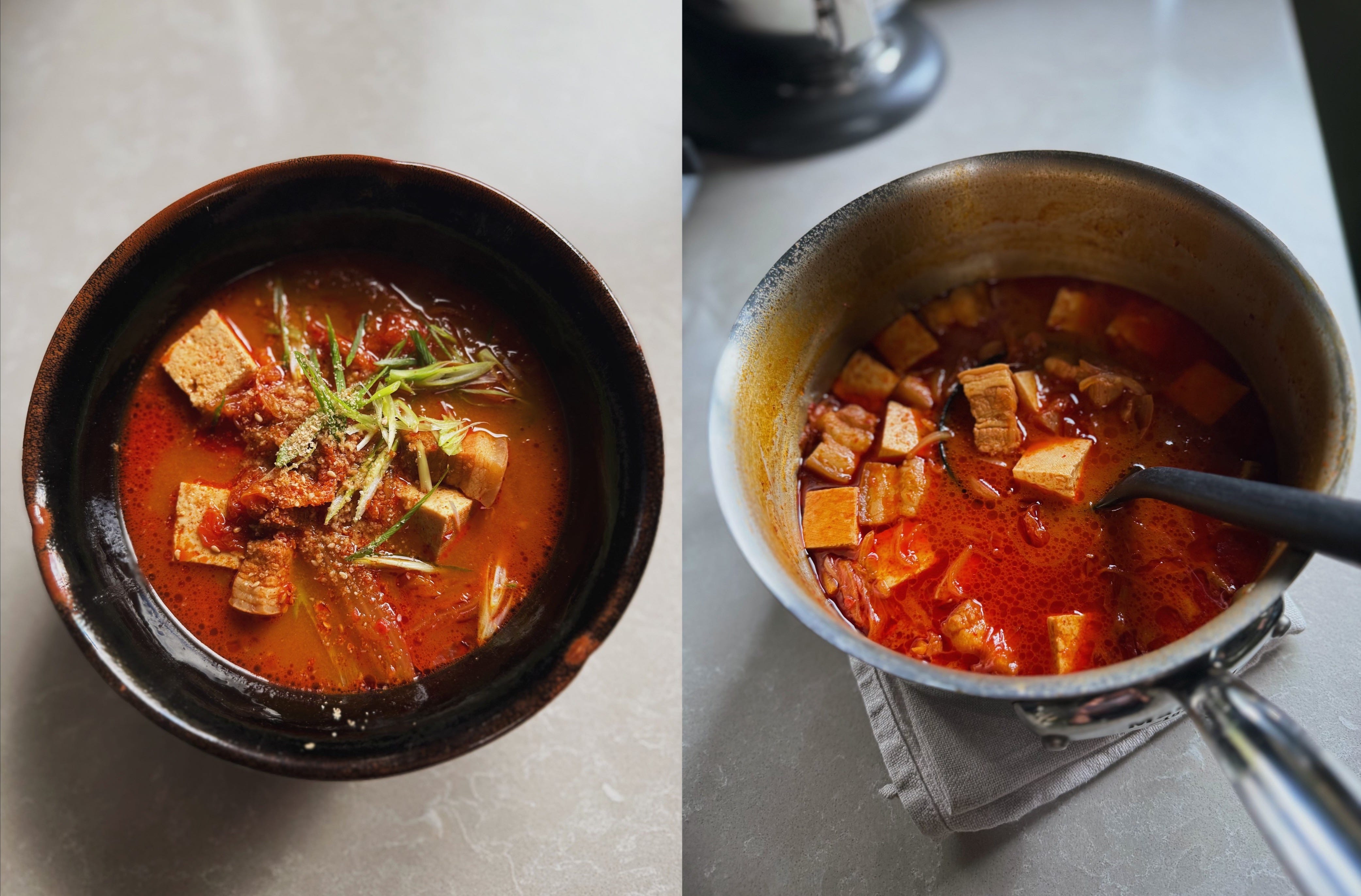
The recipe below has evolved from my book, Rice Table, and is the one I return to time and time again as my starting point. You can use the same quantity of seasoning as a benchmark in proportion to the liquid, even if you omit the meat or substitute with other protein. Both doenjang and gochujang are used to amplify the depth of umami, with doenjang in particular helping to soften the acidity of the kimchi while balancing the overall richness of the pork. Shrimp paste or fish sauce brings the salinity forward note, supporting the overall flavour. If no meat is added, use stock as described above.
I quite like the gelatinous texture of skin of the pork belly in this stew; feel free to remove it, if preferred.
