
Cut Cabbage Kimchi
Kimchi is a family history locked in a jar.

Welcome to Simple Supper.
The internet is flooded with kimchi recipes. So why am I sharing mine? What could I possibly add to the thousands already out there?
To me, making kimchi has always felt therapeutic. It is a reliable ritual that nourishes me long before I get to enjoy the finished jar. I suppose, as with everything I write about, it is the meaning behind kimchi that I am more interested in. The role it plays in my kitchen: how it has become the taste of our home; how it shapes our family life. And of course, a recipe and tips, in hope it will encourage you to have a go yourself, to make it yours.
Simple Supper is a reader-supported publication about home cooking, rooted in Korean tradition and the everyday rituals that hold a family together.
Subscribe to follow along.
You don’t need me to tell you how familiar we all are with kimchi nowadays. You only need to step into any large supermarket to find them. You can find it sitting comfortably on refrigerated shelves, bubbling lively in jars beside sauerkraut or yogurt. I would like to think that you can safely trust most of them to taste reasonably good. Increasingly, and more frequently, I have even seen - and this is more worryingly - ones packed neatly into pouches or jars, in the ambient isles. The fact that they’ve become shelf-stable makes me question whether they are even alive. If kimchi is no longer alive - actively fermenting, evolving from a freshly made to magnificently effervescent with happy microbes - then it certainly is not the kimchi I grew up knowing. It seems to me that the more popular kimchi becomes, the less certain I am if we all mean the same thing at all.
So what is kimchi? What makes kimchi, kimchi?
While the word kimchi is most commonly associated with napa cabbage here in the West, different varieties of kimchi can stack up to almost 200 throughout Korea.
In coastal areas, kimchi draws its flavour heavily from the sea. In the southern regions with warmer climates, it tends to be saltier and spicier for better preservation, while those in cooler climates produce cleaner tasting kimchi with a restrained use of gochugaru (Korean red pepper flakes). Kimchi from mountainous region in the north-east of Korea is often simpler in its use of vegetables due to the lack of variety of fresh local produce, but richer in flavour through the use of abundant seafood. From mineral-rich oysters to milky-white bone broth, locality is expressed through ingredients used, leaving a unique regional impression and diverse depth of flavour on every batch.
Taught in the kitchens led by matriarchs, kimchi is a family history locked in a jar.
Kimchi isn’t just a hot health trend or a gut-health hack. It represents something far more fundamentally important. Once merely a solution for survival, this ancient practice of preserving vegetables became, over time, a national symbol of hardship, resilience and ingenious creativity. The journey that began simply with salting vegetables has continued to evolve throughout a history spanning over 1,500 years.
Taught in the kitchens led by matriarchs, kimchi is a family history locked in a jar. It changes every season, forever evolving, forever witnessing to carry stories forward as we gather and part, remember and forget, and give and receive. It is a practice handed down through years of observation. A skill and a body of knowledge inherited almost unconsciously, absorbed into your muscle memory simply by practicing. It is a taste of home. An instinctive taste of our mother tongue that we know by heart.
We preserve in order to practice the community spirit of sharing and cooperation, and to remain in tune with the philosophy of living in harmony with nature. To me, it is one of the most human things that celebrates the spirit of humanity. So much so that the annual practice of gimjang (also known as kimjang) - the communal making and sharing of kimchi - was inscribed on UNESCO’s Representative List of the Intangible Cultural Heritage of Humanity in 2013, recognising the importance of the practice, rather than the kimchi itself.
I wanted people to taste the kimchi seasoned with longing.
The first time I felt a sense of community was back in 2020, when I was selling small-batch kimchi made in my tiny kitchen through Instagram. I had barely 1,000 followers and was still navigating the tail end of my depression, brought on by a cultural identity crisis after childbirth. I had just won an Observer Food Magazine Award with my kimchi jjigae recipe - the dish that gave me my first real taste of home again - and I felt compelled to share my story.
I wanted to be open about how lost I felt moving through new motherhood without a village, belonging fully to neither Korea nor Britain, and how I was able to reconnect with my Korean heritage through cooking the dishes from the memories of my childhood back home. I wanted people to taste the kimchi seasoned with longing. Strangers became supporters. Supporters became friends. Through a jar of kimchi, I was finally able to feel a sense of belonging.
When I am making kimchi, I think of a jar to send away with Vince, hoping he will feel cared for. I take a jar to a friend who has invited me to dinner, to say thank you for making me feel part of your family. I take great pleasure in smooshing cabbages with loving hands in front of my daughter, who wrinkles her nose and teases me that it smells like stinky cheese, because I know, in my heart, that this ritual is in her as much as it belongs to me.
In the New York Times article, Eric Kim, the author of Korean American, writes that we should think of kimchi as a verb. He proposes that kimchi shouldn’t just be viewed as a rigid noun but rather as an adaptable action or process that can be applied to almost any seasonal vegetable.
I think kimchi as a verb places emphasis on the act of making a kimchi itself: the process of salting, rinsing, draining, preparing the kimchiso (kimchi filling or paste). More importantly though, for me, at the heart of that doing are the people - those who gather to hold space for tradition. Kimchi is an act of care that preserves a culture. It is an active participation in remembering, to practice and continue a tradition that is both deeply personal and profoundly national.
So what does it mean for me to practice making kimchi over and over here in my own kitchen? What do we actually preserve when we make kimchi?
For me, kimchi is a living cultural practice that carries forward a story of who I am, through the simple act of making it. Kimchi is the taste of home that I seek to preserve and a bridge that connects me to my roots; my ancestors; my family; my community. It shows me how Koreans understand the changing of the seasons. It is a small way in which I can carry my family’s lineage into the future.
From my grandmother to my mother, to me and to my child, no two versions of kimchi remain exactly the same, yet the stories of our lives continue, alive with the energy we breathe in to them in this very present moment. A real, tangible connection between the past, present and future.
Cut Cabbage Kimchi
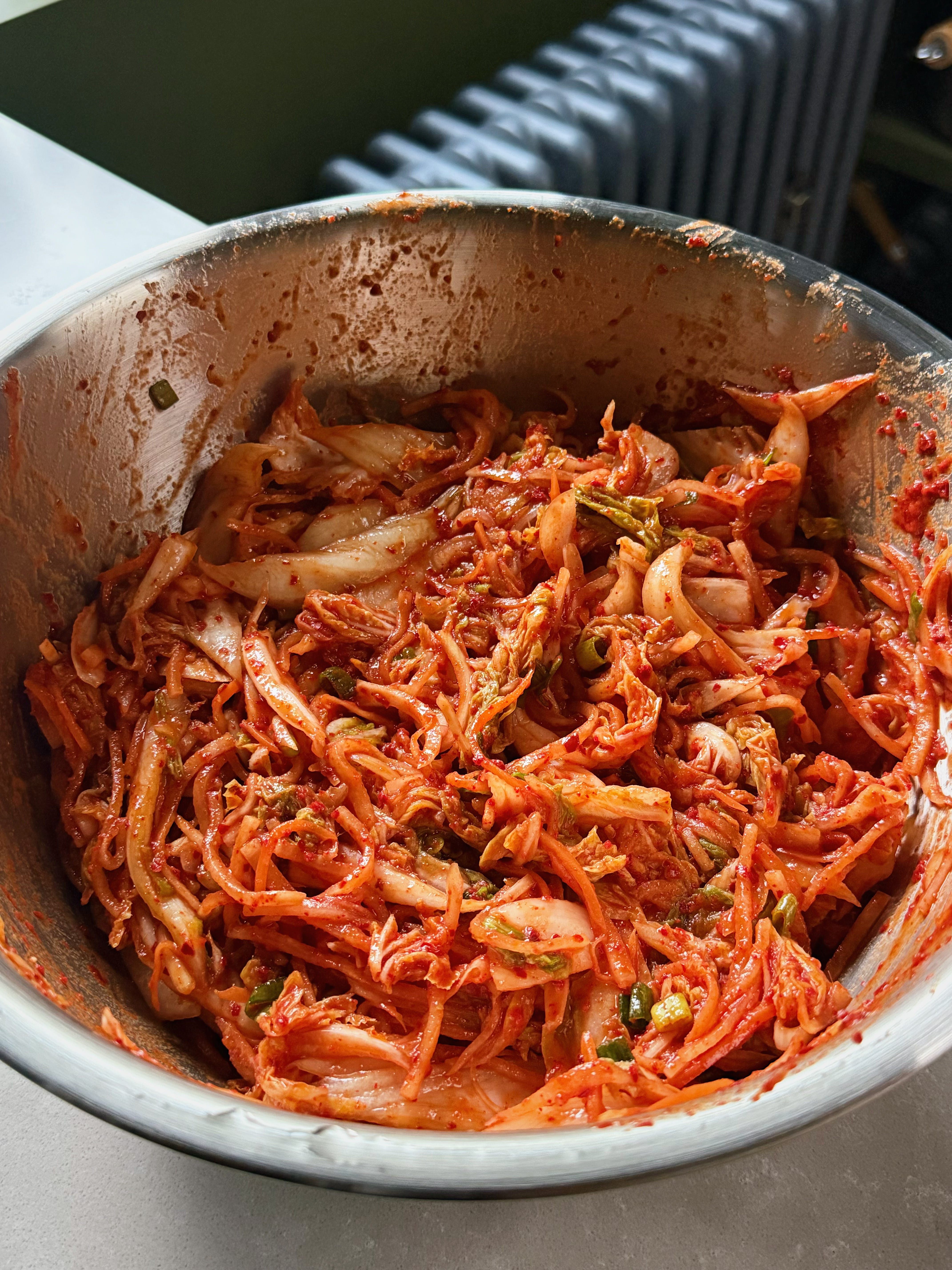
The most classic type of kimchi we associate with is made with napa cabbage (Chinese leaf cabbage). Traditionally, the cabbages are either quartered with its leaves remain attached to core and swaddled tightly like a baby before being packed in the jar. Or they can also be cut into bite-sized pieces for convenience.
Generally speaking, whole quarters ferment more slowly. The fermentation process takes little longer to reach the optimum population of lactic acid bacteria, making them better suited to large batches intended for long-term storage. Meanwhile, cut cabbage ferments more quickly as there is more exposed surface area for the beneficial bacteria to work on. The flavours develop faster, making it ideal for smaller batches.
As the temperature of a home refrigerator constantly fluctuates with daily use, I much prefer making cut cabbage kimchi in smaller, more frequent batches. It means I can enjoy properly ripened kimchi more consistently instead of large batches sitting in the fridge at length with impaired quality due to the inconsistent condition.
The internet is flooded with kimchi recipes, but I would like to share a few practical pointers that will help you avoid common mistakes and, hopefully, encourage you to have a go yourself. Because for me, making kimchi has always been a therapeutic practice, and the reward is that you get to eat it afterwards.
Give Yourself Enough Time
Kimchi is not difficult to make, but it does require a chunk of time from start to finish. I like to start salting the cabbage first thing in the morning. Depending on how much time I have, I either prepare the kimchi paste the day before and keep it in the fridge, or make it while the cabbage is salting. After that, the remaining hands-on work comes together quite quickly once the salting process is complete. The key, I think, is allowing yourself enough time to enjoy the process rather than rushing through it.
Don’t Cut the Cabbage Too Small
The way we cut vegetables has a significant impact on both texture and flavour. Larger pieces create a better balance between the smooth surfaces of the leaves and the porous cut edges, helping the cabbage retain its structure throughout fermentation. It encourages better interaction among them to develop more flavourful kimchi.
We do not shred the cabbage. Full stop.
Pay Attention to the Salt
How we salt the cabbage matters.
The optimum salinity of the salting water is usually between 10-12% for the spring cabbage and 12-15% for the autumn and winter harvest. This is based on cabbages that are packed tight and dense, and is cut into quarter, not sliced.
In majority of cases, aiming for 12% salt solution for quartered cabbage would be a failsafe way.
For cut cabbage kimchi, however, much less salt is needed as the increased surface area allows the brine to penetrate quicker. I found hitting at around 6.5-7% works perfectly for me, with the remainder of the salt level coming from the final seasoning of kimchi paste itself.
Salting time will also vary depending on the ambient temperature. A warm kitchen will move things along much faster than a cool one.
So how do we work this out? To calculate the amount of salt needed:
Water (g) × target salinity (%) ÷ 100 = salt required (g)
Rinse Thoroughly
Rinsing is an important step.
The purpose of salting is not only to season the cabbage but also to prepare it for fermentation by creating the right environment for beneficial bacteria to thrive. Once the cabbage is properly salted, rinse it thoroughly several times to remove excess salt, dirt and anything else you don’t want finding its way into your kimchi.
Drain Properly
Patience pays off here.
Do not squeeze the cabbage as though you are wringing out a wet cloth. The structure of cabbage is delicate and largely composed of water. You want to keep the structure intact to give you the satisfying crunch. Crushing it unnecessarily damages that structure and can affect the final texture.
Instead, allow the cabbage to drain naturally and completely, however long it takes.
Don’t Blitz the Gochugaru
One of the most common mistakes I see online is people blending gochugaru into a paste.
As a general rule, for kimchi, gochugaru should be coarse. The fermentation process requires breathable surfaces. Not only does coarse gochugaru create the characteristic texture and appearance of kimchi paste, but it also helps maintain a more open structure within the seasoning mixture.
Blitzing coarse gochugaru into a fine powder not only makes the paste muddy, but also packs everything too densely, disrupting the right environment for healthy and diverse microbial growth. Gochugaru plays a key role in creating a desired conditions for optimum fermentation process. If you would like to read more about the role gochugaru plays in kimchi, you can read it here.
